Costa's Hummingbird

Costa's Hummingbird

Saturday, June 1, 2013

Tom's Thumb Trail - 31 May 2013

Finally, today was the day to take part in the McDowell Sonoran Preserve transect survey.  This transect survey covers a length of the Tom's Thumb trail that can be found between emergency markers EE1 to TT9.  This is a length of about a 1 mile, but it is at almost the top of saddle area near Tom's Thumb Peak, so one has to navigate a little over 1½ miles of the steep trail to actually get to EE1.  Glad I made this trip a week ago as a scouting trip, this journey was much easier with fewer sore muscles at the end.  I joined Mike Nolan, the Executive Director of the McDowell Sonoran Conservancy on this survey.  I felt honored that Walter Thurber invited me to join Mike on this trip.  Not sure how much I really contributed to the overall effort, but the extra set of eyes is always an asset when observing and counting birds is involved.

Since this was a hike that was more focused on the survey, my photography took a second seat and since the lizards were easier to photograph than the birds, I actually took more photos of them and more scenic photos to show how beautiful this place really is.  The Tom's Thumb Trail is considered a difficult trail, so if one is a novice to hiking, you might want to reconsider the hike.  And as always, when hiking in the desert, always carry an ample supply of water.

First off, I will start off with a couple of photos of Tom's Thumb which stands out from miles around.  Both photos were taken in the parking lot of the trail head before the start of the hike; one with my point-and-shoot camera and then one with my DSLR camera with my zoom lens attached.  Kind of puts the distance into perspective a bit more.


Photos of birds only included Canyon Towhee, Black-throated Sparrow, and Brown-headed Cowbird.  The Towhees and Sparrows are birds that are fairly common in the right habitats in Arizona.  But this location has to have one of the highest concentrations of Canyon Towhees that I have seen.  Both of these species were found at the lower elevations and all the way to the top.  Some of the other species were found only at certain elevations.  And the last photo of a bird was a female Brown-headed Cowbird which greeted us at the trail head area when we returned.

 Black-throated Sparrow

Canyon Towhee

Brown-headed Cowbird

Lizards were seen at every elevation and today were a little less time consuming for taking photos.  They are always an interesting creature and the more I see them, I think I will get better at identifying them in the field. Currently, many of my lizard identifications take place when I see their photos on my computer at home where I can study them a bit closer.

 Common Side-blotched Lizard

Ornate Tree Lizard

And we had one Rock Squirrel that posed for us on a distant rock, or should I say boulder!

Rock Squirrel

The next photo is the back side of Tom's Thumb.  This rock formation juts up from the ridge about 300' and the photo does have a giant Saguaro Cactus in it down below and to the right of center, which helps to put the size of the rock formation into perspective.

Tom's Thumb-backside

At various spots along the trail, the views of the surrounding areas are incredible.  

 Mountains to the east of the transect area
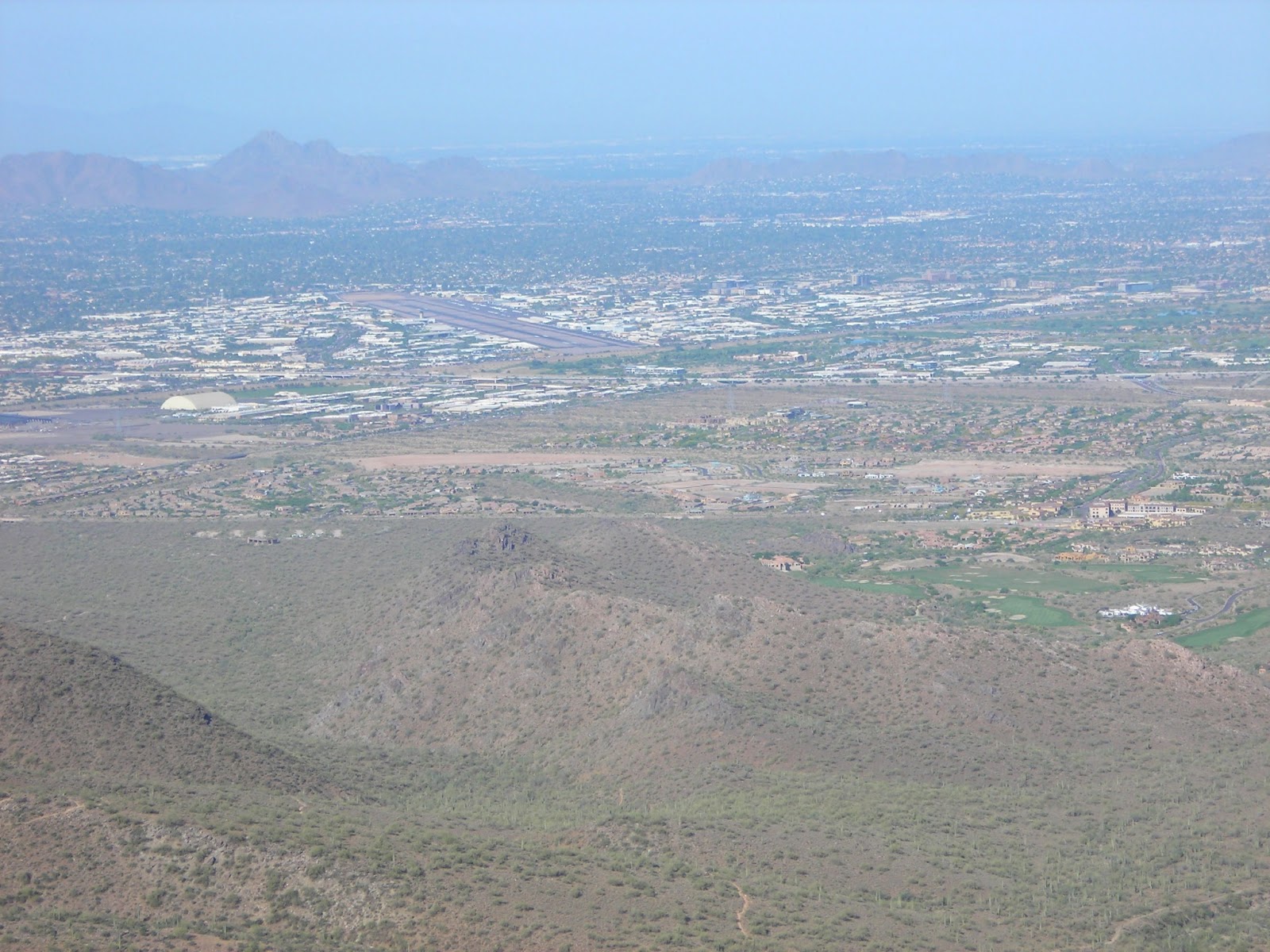
 Scottsdale and its airport

Pinnacle Peak-upper left center

And finally during our descent, one photo to show the valley to the north.  This photo also shows the trail head where our vehicles are parked.  You can see the trail head on the right part of the photo in the center, the low dark brown shelter looking building with the parking lot behind it.  To get to the trail head, the road is now an improved road as seen by the black top road coming in from the north.

North valley-the road in and trail head center right.

We did have lots of nice birds including Black-chinned Sparrows and Rufous-crowned Sparrows and numerous hummingbirds especially in the higher elevations.  If nothing else, the beauty of this place is remarkable and after visiting many places in Arizona, this one is not littered with the garbage and signs of human trash.  The hikers that frequent this place have, for the most part, done a great job of 'Pack it In - Pack it Out'.




Tuesday, May 28, 2013

Pima Canyon Wash, South Mountain Park - 26 May 2013

After surviving my more strenuous hike to Tom's Thumb on Saturday, I decided to head out to one of my regular spots, Pima Canyon Wash in South Mountain Park.  But this time I added a variation and once the wash came to the CCC structure and the beginning of the National Trail, I ventured up to higher elevations to try and locate a back trail down into the wash area.  I found one, but it is not one that I would recommend to most people as I found a couple of spots where I was not sure how I was going to make it down the huge house sized boulders into the valley below.  This hike totaled 5.6 miles of hiking and an elevation gain of about 600', but what a beautiful canyon to be hiking in and I only found 1 other person in the canyon.  

Since my hike started at 5:30 AM the first part was right at sunrise and one of the first birds I was able to photograph was an Ash-throated Flycatcher, fledgling/juvenile.  There were 4 of these birds in the wash area and it appeared to be 2 adults and 2 offspring from this year's first breeding as they followed the parents and were constantly begging.  I was able to only get one photo when one of them landed in a bush for a brief moment with the sunlight creating an interesting background color.

Ash-throated Flycatcher

A bit further up the wash I encountered one of my favorite resident birds for this spot, the Black-tailed Gnatcatcher.  There were actually 2 of these birds in this bush; a male parent and a fledgling/juvenile.  I tried my usual pishing, as this species will sometimes react to that and come closer for a better view.  Well the young one was quite receptive and came out to the front of the bush to really check me out.  Apparently, dad has been fooled more than once as he was not going to have any of this and stayed fairly well hidden in the branches of the bush.

 Black-tailed Gnatcatcher

Black-tailed Gnatcatcher

Up on the upper ridge a Curve-billed Thrasher landed on a Saguaro and as I was trying to focus in on it, a White-winged Dove landed on another arm of this same Saguaro. 

 Curve-billed Thrasher

White-winged Dove

The White-winged Dove is quite a handsome dove when compared to its more common cousin the Mourning Dove which is probably the 2nd most common dove in the United States. Most of the time I do not bother with photographing the Mourning Dove as most people see them on a daily basis.

Mourning Dove

A female Ladderback Woodpecker made her presence know by calling and then showing herself on a branch of a tree.

Ladderback Woodpecker

Non-avian species included a Harris's Antelope Ground Squirrel and a pair of Rock Squirrels.  

 Harris's Antelope Ground Squirrel

Rock Squirrels

It almost amazes me to see some of the plant growth in the inhospitable places such as these 2 cacti growing out of a crack in a rock.  Always wonder how 2 seeds got dispersed into a small crevice and then had just the right conditions to germinate and sprout and then grow into a substantial plant.


Will end the post with a couple of scenic photos; one looking through a saddle between a couple of mountains at a small portion of the great city of Phoenix in the far background.  The other is a ravine full of boulders and rocks and somewhere far in the distance is the parking lot where my car is parked.  This is the ravine that took me back to the start and required a bit more serious hiking and maneuvering between the rocks.

 View of a bit of Phoenix in the far background

Somewhere in the far distance and to the right my car is parked.


Monday, May 27, 2013

Tom's Thumb Trail - 25 May 2013

Saturday morning I made an early start to the day by arriving at 5:30 AM at the trail head of the Tom's Thumb Trail in the McDowell Sonoran Preserve near Scottsdale, AZ.  I wanted to do a bit of a scouting of this place due to the fact that I am going to be part of a birding survey for the upper elevations of this area in the very near future. I knew this was going to be a bit strenuous of a hike.  Elevation at the trail head is about 2760' and the elevation at the base of Tom's Thumb rock formation is 3840'.  So it is a gain of almost 1000' in elevation on this trail and the overall distance one-way is about 2½ miles.  Yes, it was slow going up the trail for me as this is a bit more than what I am used to, but it was really worth it.  Not only did I get some much needed exercise, the views were awesome from above.  

Birds were definitely out in full force with evidence of many species having already raised at least 1 brood of babies.  I found fledglings/juveniles of Say's Phoebes, Canyon Towhees, Black-throated Sparrows, and hummingbirds, most notably Anna's and Costa's Hummingbirds.  Most of the birds were not very cooperative for me an my camera, so bird photos were not meant to be.  But I did capture some photos of some other critters that made up for the bird photos.  Also on the hike to the top, I did spy a Gray Fox on the far side of a ravine, but it eluded me and had disappeared before I could get me camera on it.  Say's Phoebe's were at the beginning of the trail and the fledglings were still being partially fed by parent birds.
  
 Say's Phoebe at sunrise

Say's Phoebe, fledgling on the left with traces of its yellow gape.

All along the trail at higher elevations, hummingbirds were abundant and most were juveniles and/or females making it harder to identify each one when they flew by.  But many could be identified by voice and/or behavior.  The only male that I actually saw was a male Anna's Hummingbird feeding on little red flowers that were scattered all along the slopes.  Those flowers has to be one of the reason there are so many hummers along this trail.  

 Anna's Hummingbird

A hummingbird favorite

Near the top, I discovered some Black-chinned Sparrows and this is a species that the study would like to verify if they might be breeding in this location.  Even though none of them cooperated with me and my camera, it was a great find for me to find them this close to the Phoenix urban area.

Black-chinned Sparrow

At the base of the Tom's Thumb rock formation, I was able to photograph a California Patch Butterfly, which was a new species for me.  Another insect that caught my eye in the area of the saddle of the trail was a wasp, that appeared different to me as well.  I managed to capture a couple of photos of it and have since learned that it is a Female Sphex lucae which is a solitary wasp that hunts katydids as food for its offspring.  Thanks to Eric Eaton from Facebook with the ID on this wasp.

California Patch Butterfly

Female Sphex lucae Wasp

Lizards of various kinds were also in abundance all along the trail.  Here are 3 that I managed to capture photos:  Greater Earless Lizard, Zebras-tailed Lizard in the process of shedding its skin, and I think an Ornate Tree Lizard, but I am not 100% sure it this one as its tail appears much longer than this species should have.

 Greater Earless Lizard

 Zebra-tailed Lizard, shedding its skin

Ornate Tree Lizard

The red flowers that the hummingbirds were particularly fond of were not the only flowers I found.  A nice low spreading purple flower caught my eye as well as a Jojoba bush with nuts setting on quite nicely.

 Jojoba Nut


And to show off the beauty of this place, one scenic photo looking out over the valley to the north.


This was a bit of a strenuous hike and one that no one should attempt without ample water.  I logged in 5.24 miles with a elevation gain of about 1000', so the muscles were put to the test.  I could feel it the next day, but on the next blog you will see that I went out to another trail and did almost the same the very next day..


Wednesday, May 22, 2013

Willcox, Arizona - 18 May 2013

Well this was the first spot that I visited with Chris Rohrer this past weekend.  I had to post Sunday's adventure first due to the finding of the Elegant Trogon. But Saturday was also an exceptional day of birding as well.  It all started very early with a trip to Willcox, Arizona and its small lake south of town that is notorious for being a hot spot for rarities of shorebirds and this weekend was no exception. This small lake was was very well represented with a variety of shore birds.  

One of the nicest finds was the Snowy Plover.  This is a very small shorebird that is not too common in Arizona as they pass through on migration.  I had only seen one of these birds once before at a pond near Phoenix, but this day we found 2 of them which was a life bird for Chris.  The pond held several dozen phalaropes with most of them being Wilson's Phalaropes and a sprinkling of Red-necked Phalaropes.  I had seen both species before, but never in their breeding plumage.  They were decked out in their breeding plumage and these birds are a bit different than most birds.  The females are larger and are the ones all decked out in the bright and colorful plumage. Once they lay their eggs, their job is done and the males do the incubating and the raising of the young alone. 

 Snowy Plover

 Red-necked Phalarope

Red-necked Phalarope

One more photo of some sandpipers is interesting because it includes 2 different species.  In the foreground and on the left in the photo is a Western Sandpiper, which I have seen and photographed many times.  The interesting bird is the one that is a bit larger and behind it and to the right.  This is a White-rumped Sandpiper which is a rare bird in Arizona, but have been reported by several others at this location for a few days.  We also counted 14 Ring-billed Gulls at this location.

Western Sandpiper & White-rumped Sandpiper

Ring-billed Gull

All around the lake the air was filled with swallows with the majority being Barn Swallows and a few Bank Swallows.  The Barn Swallows are a very familiar bird to me as we had them every summer nesting in our barn on the farm in Nebraska.  The Bank Swallow actually was a new bird for me.  Not sure why I have never seen one before or even pursued one, but it is now on my list.  It is our smallest swallow in the United States.

 Bank Swallow

Barn Swallow

Chris knew that I had been wanted to add the Scaled Quail to my list and he did not disappoint me.  We got to view 6 of them.  While my photos are not what I consider the best, at least it is no longer one of those nemesis birds and maybe in the future I can obtain better photos.

Scaled Quail

Other birds and creatures seen at Willcox Lake were Eared Grebes, a nesting American Avocet, and a very unusual but lovely horny toad with a proper name of Texas Horned Lizard.

 Eared Grebe

 American Avocet on nest

Texas Horned Lizard

After leaving Willcox, we headed back to the Tucson area with a short stop in Benson, but the gates to the waste water treatment ponds were closed so we stopped at the Golf Course and found some Ruddy Ducks and the males were in full breeding plumage.  What a colorful little duck!

Ruddy Duck

This day was far from being over.  Our journey then took us to Madera Canyon in the late afternoon and into the evening.  The goal was to finally spot an Elf Owl.  This is our smallest owl in the United States at just under 6".  It is a migrant that nests in the southern areas of the southwest, primarily Arizona, New Mexico, and Texas.  Obviously, since it is a nocturnal bird, photos can be a challenge.  I got but one photo as I did not want to disturb it any more than necessary since it was nesting and just coming out of its nest for its night time of feasting on primarily insects.

Elf Owl

While waiting on the Elf Owl to show itself, we had the pleasure of observing a flock of Wild Turkeys moving up the canyon to bed down for the night and the tom turkey was definitely in a protective mode as it stood its ground in the middle of the road until its harem of females were safely on the other side.

Wild Turkey

After the darkness settled in around us, then we had the pleasure of seeing and/or hearing a few more nocturnal birds.  Whiskered Screech Owls were calling in the distance and although it was fairly dark, we caught glimpses of a few bats, some Lesser Nighthawks, and a couple of Mexican Whip-poor-wills.  The Whip-poor-wills became very vocal as they would land in trees and do a lot of calling.  It was a long day, but a very fruitful day for both of us.