Costa's Hummingbird

Costa's Hummingbird

Saturday, November 10, 2012

Pima Canyon Wash-8 & 9 Nov 2012

With decidedly cooler temps in the Phoenix area, I have been taking advantage of the nice weather and going straight to South Mountain Park when I leave work.  That way I get much more exercise hiking 3 to 4 miles than I do on the treadmill at home.  And it sure is a lot more fun being out with nature!  So Thursday and Friday I went to my regular haunt and although most of the birds I found were the regulars, I did find a surprise waiting for me on Friday.  Ash-throated Flycatchers are a fairly common bird in Arizona in the spring and summer, but they migrate south for the winter and I had not seen one for about 6 weeks until Friday and then I was quite surprised to find one in Pima Canyon Wash and it was a beautiful specimen at that.  Guess it had not got the memo to fly south!
 
Ash-throated Flycatcher
 
Also found on both days were some Gilded Flickers, but my Friday adventure proved a bit more fruitful for photos as I was able to get both a male and a female in the same tree.  The Gilded Flicker's range in the United States is pretty much limited to Arizona and the extreme southern parts of Nevada and eastern fringes of California.  So it is another one of those birds that birders in other states try to find when they make a trip to Arizona
 
 Gilded Flicker-Female
 
Gilded Flicker-Male
 
The Black-tailed Gnatcatcher is a bird I see on just about every trip to this area and they happen to be one of my favorite birds of South Mountain Park. Hopefully no one tires of my photos of these 4" little dynamos as it is always a challenge to capture them in photos.
 
 Black-tailed Gnatcatcher
 
This male House Finch was tucked down in a bush preparing for a pretty chilly night (at least chilly by Phoenix standards!)
 
 House Finch-Male
 
This Killdeer photo really does not fit the mold of this visit, but it just happened to be hanging around the golf course that borders the entrance to Pima Canyon Wash.
 
Killdeer
 
The Black-throated Sparrow is probably my favorite sparrow and I can always find them on my trips to this area.  Sometimes they are a bit harder to find than other times, but they can be easily overlooked.  And this time I witnessed a new behavior from this species.  They can raise their head feathers into a crest, similar to some of the flycatchers.   I had not seen this until now.
 
Black-throated Sparrow
 

And of course we can't forget the ever popular Cactus Wren and this one obliged by parking itself within some cactus just as their name implies.
 
Cactus Wren
 

And if some of you think I am only interested in birds, every once in a while some other critter makes themselves visible and allows a photo or two such as this Harris' Antelope Ground Squirrel.
 
Harris's Antelope Ground Squirrel
 

For those of you that are a bit more interested in history, this canyon and park is full of petroglyphs which were created long ago by the Hohokum people that inhabited the Salt River Valley thousands of years ago.  There are hundreds to be found in the park and unfortunately some of them have been marred by current humans.  If you go hiking, please enjoy these unique wonders and leave them for future generations to admire.  They are a living tribute to the Hohokum people.
 
Petroglyph


Petroglyph


Wednesday, November 7, 2012

South Mountain Park-Javalina Trail

Had the option today to tackle a trail in South Mountain Park, or head home and put some time in on the old treadmill.  Well let me tell you, 3½ miles on a hiking trail at 90° was a whole lot more fun than 1½ miles on the treadmill at home.  This was not the first time I had been on this trail, but it was close to where I work and stopping here was an easy choice.  It is a trail that ventures through some very dry areas of South Mountain Park.  Not a hot spot for birding by any means, but our avian friends are there, but you have to listen and look for them.  Came home with photos of a bunch of brown birds; not what most people would consider as an exciting bird outing.  The nicest bird that I saw but was not able to capture a photo was a Greater Roadrunner.  Always nice to find them.  So my photo album consists of common brown birds of South Mountain Park.
 
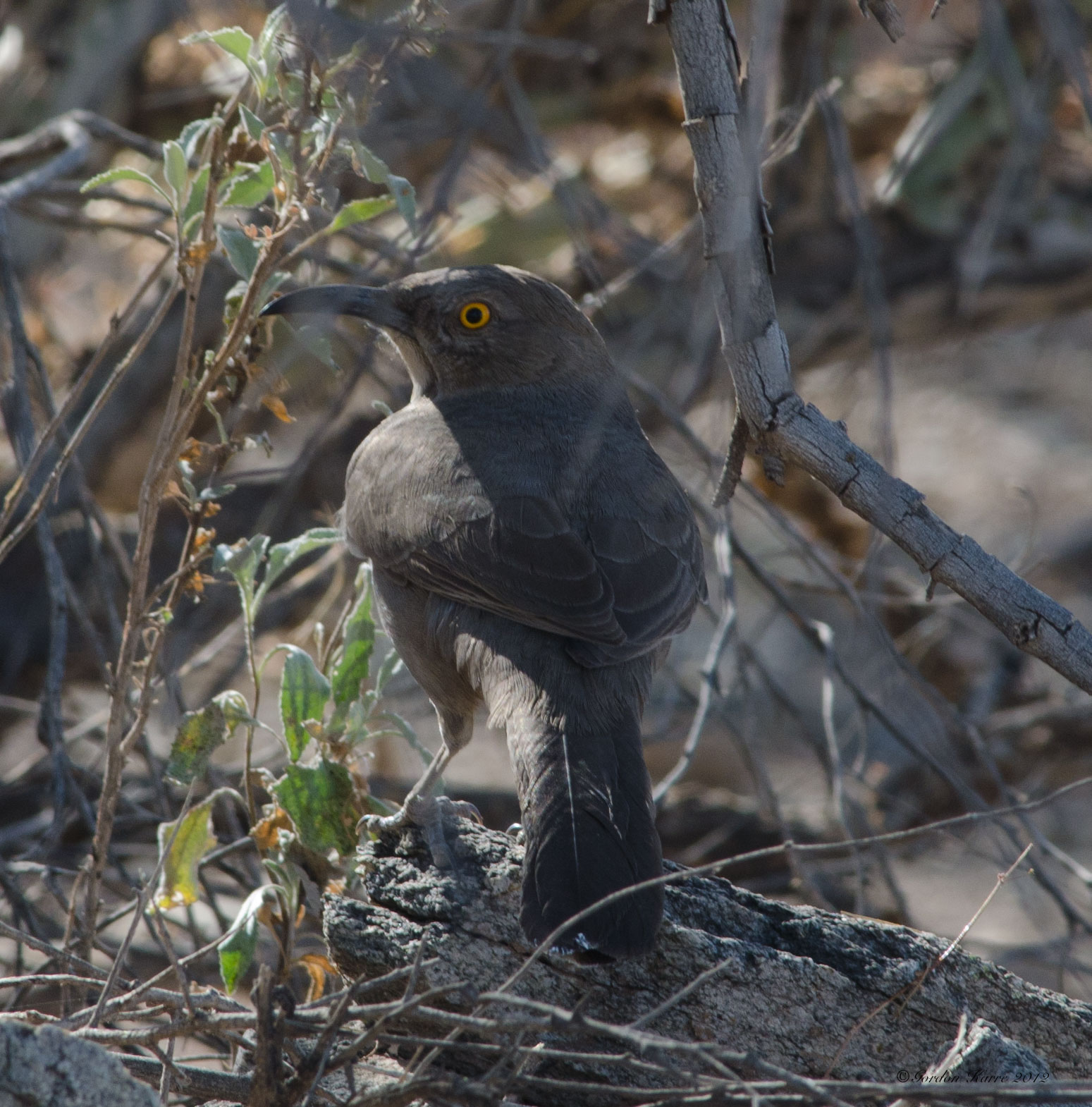
First 2 birds that I encountered was a Curve-billed Thrasher and a Mourning Dove.  The thrasher just did not want to come out in the open, so I had to settle for an 'under the bush' shot with bad lighting.  Even though they are a 'brown' bird, their gold eyes are very captivating.  The Mourning Dove is a bird that I rarely photograph, we see them on just about every birding trip and they are also common backyard feeders at my home.  Plus they are found just about everywhere in the US.
 
 Curve-billed Thrasher
 
Mourning Dove
 
Near one of the washes, I was observing a couple of Black-tailed Gnatcatchers, but got side tracked when a couple of Black-throated Sparrows flew into the base of the shrub.  So I was torn between the 2 species and what I should try to capture with the camera.  Neither one was offering me great views, but nevertheless, I attempted to capture photos anyway.  So these are the best of my feeble attempts to photograph both species.
 
 Black-tailed Gnatcatcher
 
Black-throated Sparrows-note there are 2 in this photo
 
The last birds that I was able to shoot with my camera were a Rock Wren and a female House Finch.  Sad to say, but I can't really recall ever photographing a female House Finch; usually spend more time focusing on the males.  But in reality, this female today actually presented my best bird pose of the day and in the right lighting.  So it is about time I added the female House Finch to my photo albums.  The Rock Wren was a featured bird for me sometime back on my blog.
 
 House Finch-female
 
Rock Wren

So ends my saga of 'boring brown birds' for the day.  They may be boring in coloration, but they are far from being boring when one is watching them to learn behavior or listening to them to become familiar with their calls.  They are just as fascinating as the brightly colored birds.


Sunday, November 4, 2012

Papago Park and Desert Botanical Gardens - 3 Nov 2012

Today, the destinations I chose were Papago Park and the Desert Botanical Gardens for my birding adventure.  Started out very early at Papago Park which is just outside the Phoenix Zoo and I was in search of a female Hooded Merganser that had been hanging out there for some time and I had not yet seen a 'Hoodie' this year, so figured it was worth a look if I could find it.  Arrived before sun-up, and walked the 3 small ponds with no sight of it and decided that  I had missed it.  As I was thinking about leaving and proceeding on to the Desert Botanical Gardens, (which is almost right next door), I bumped into a couple of Facebook birders/photographers (or maybe that should be reversed), Bryan and Ruth, and visited with them for a while and during our conversation another good friend, Muriel arrived, so I was in really good company.  Finally I headed out to the DBG and while I was there, Bryan and Ruth showed up there as well and advised me that they finally found the 'Hoodie" back at Papago Park so when I left DBG, I stopped by to see it and capture a couple of photos.
 
Hooded Merganser-Female
 

Hooded Merganser-Female
 

Hooded Merganser-Female
 
The rest of this blog post is all about my visit to the Desert Botanical Gardens.  At the admissions booth a nice young man approached me and asked me if I was a birder and so we struck up a conversation about birding and Robert was in town from Vancouver, so we joined forces to do some birding while we were there.  Many of our southwestern birds were new to him, so I hope he enjoyed the visit and came away with some new life birds. 
 
During our walks on the trails, we managed to find some Rosy-faced Lovebirds feasting on some sunflowers and once they departed a male Lesser Goldfinch paid a visit to the same flowers.  For those that are interested, the lovebird has established a strong breeding population in the Phoenix area and is now a recognized species in most birding associations.
 
Rosy-faced Lovebirds
 

 Lesser Goldfinch
 
We also found a sleeping Great-horned Owl and preferred to let it sleep and not arouse it from its slumber.  Also had to throw in a photo of a Gila Woodpecker for Robert's sake.
 
 Great-horned Owl
 
Gila Woodpecker

This last set of photos is a bit unique due to the fact that I found 2 species of gnatcatchers during my visit.  The Blue-gray Gnatcatcher made an appearance early on, and the Black-tailed Gnatcatcher made an appearance during my exit.  These 2 birds are very similar in appearance to the novice birder and can be confused, especially in winter plumage, when first getting into birding.  The biggest difference is trying to see the undersides of their tails.  The Blue-gray has white on the underside while the Black-tailed is obviously black.  But considering how busy they are, this is not always an easy task while they are flitting around in the foliage.  They also have a different call which takes a bit of time to learn.  In my photos, I was fortunate to capture a photo of the Blue-gray's underside of the tail and one can see the white.  No such luck on the Black-tailed photos, but believe me, the photos below are of a Black-tailed.
 
 Blue-gray Gnatcatcher
 
 Black-tailed Gnatcatcher
 
Black-tailed Gnatcatcher
 
Another fine day for birding in Arizona and some interesting birds as well.


Thursday, November 1, 2012

Gilbert Riparian Water Preserve - 31 Oct 2012

After returning from Lake Havasu, we were getting several reports of a couple rare birds being sighted at the Gilbert Riparian Water Preserve; at least the 2 bird species are considered rare for Arizona.  And since this birding hot spot is only about 6 miles from my home, I had to venture out to see what I could find.  Sunday I struck out on both birds, but being tired and hot, I suppose that can be expected.  So I ventured out again on Wednesday and also met one of my birding friends, Ellen,  and she helped me locate one of the birds, a Chestnut-sided Warbler.  This bird is a rare but casual migrant to Arizona and the bird has been hanging around for about a week now and it appears to be a first winter female.  A male in breeding plumage would be ideal, but when it comes to a new life bird, one can't be too picky.  First glimpses of the bird was in dense foliage on the back side of a mesquite tree and was good enough for an ID, but no photos.  So we moved on down the path to the end and returned to find it flying across our path into another mesquite, but this time she became very cooperative and actually exposed herself on some branches and allowed nice photos.  I guess patience can be a virtue at times and the photos below were worth the wait.
 
 Chestnut-sided Warbler
 
 Chestnut-sided Warbler
 
Chestnut-sided Warbler
 
Of course this place is very well known for its water birds and even though the Black-necked Stilt is a fairly common wading bird, they are also one of the most photogenic birds and then when one captures a 3 photo segment of one it makes the photos a bit more interesting as if I captured a little bit of history that no one else captured.  First the probing in the water, then the plunge, and finally the results of its tiny morsel.
 
 Black-necked Stilt
 
Black-necked Stilt
 
Black-necked Stilt
 
Another unique find was a couple of Dunlin.  While they are not considered rare, they are far less common than some of the other waders and they are usually considered a nice find and they can be tough to pick out in large flocks of other wading birds.  Of course the Long-billed Dowitchers are always quite common at this location and the lighting was just right to allow a couple of photos.  Along with that we also located at least 6 Wilson's Snipe, but they blended in with the mud so well they probably escaped the eye of most casual observers.
 
 Dunlin
 
 Long-billed Dowitcher
 
Wilson's Snipe-Look close, there are 2 in this photo.
 
As with any trip to this place, a Green Heron can almost always be found and this was no exception.  This one was lying in wait for some minnows to swim by and become part of its meal that day.
 
Green Heron
 
Since this is fall with winter approaching, the waterfowl is plentiful on the ponds right now and one of the most elegant looking birds is the Northern Pintail.  If you can call a duck elegant, this one has to near the top to fitting the description.  Also had to snap a photo of a Green-winged Teal since it made itself available.  Sometimes the teals are a bit skittish and really try to keep their distance.
 
 Northern Pintail
 
 Northern Pintail
 
Green-winged Teal


Monday, October 22, 2012

Gilbert Riparian Water Perserve - 21 Oct 2012

With my car in the shop for repair, I stayed close to home this weekend with a birding excursion on Sunday only, and I opted for the Gilbert Riparian Water Preserve which is probably the best place for racking up a lot of species of birds in one spot in the suburban area around Phoenix.  It is easy access for just about anyone and with the constant changing of water levels in the 7 ponds, you never know what you might encounter when paying a visit.  Many rarities have been seen here throughout the years and this spot is well known to just about every birder in the state of Arizona.  When I arrived at about 6:30 in the morning I quickly found another birding friend, Bernie Howe, so we then completed our adventure together.  And in the process of our birding together we did find a bit of a rarity in the birding world.  We had found a fairly large flock of Inca Doves in the plowed under sod of Pond 5 and while scanning the many doves, I discovered one that stood out as being a bit different. We had found a Ruddy Ground-Dove which is not a new bird to either of us, nor the state of Arizona, but they are quite uncommon.  Their normal breeding range is much further south in Mexico, but occasionally a stray shows up in the American southwest.  When checking on the eBird web site, for the year 2012, there has been a sighting in Texas and about a half dozen in the state of Arizona, all of them in the early part of the year.  To many people it is not a dramatic bird to view, but for those that are listing birds, it is always a nice bird to add for the year.  Below is a photo of the Ruddy Ground-Dove and also a photo of an Inca Dove, which often gets ignored (but shouldn't) by many birders.
 
Ruddy Ground-Dove

Inca Dove
 
This area of upturned sod in the south part of Pond 5 must have been a great place for feeding for the birds.  Even while we were checking out the doves, we had various sparrows flying in for visits and scavenging in the dirt for seeds and maybe even some insects.  We had a huge number of White-crowned Sparrows along with a Song Sparrow, some Savannah Sparrows, a Dark-eyed Junco, and some Abert's Towhees.  (Yes, the Junco and the Towhee belong to the Sparrow family!)  The Junco seemed a bit out of place as I normally see them in higher altitudes in pine forests.  All the birds were having a merry ole time feeding until a Northern Harrier flew over and then they all took cover in the nearby trees.
 
 White-crowned Sparrow
 
 Song Sparrow
 
 Savannah Sparrow
 
 Dark-eyed Junco
 
Abert's Towhee
 
Now on to some of the water birds that we found.  Needless to say, I saw many more birds than the number of photos I have, but that is usually the case.  While we were scanning the many ducks a Black Phoebe flew onto a sign in the pond right in front of us and posed for a couple of shots before it realized that there were people close by and then off it went!  So along with the phoebe's photo we also have photos of an American Wigeon, a Mallard drake, and an American Coot.  OK, so the Mallard is probably one of the most common ducks in the US, but that green head in the right light is still stunning.  And the coot is quite handsome when you get to see them up close.
 
 Black Phoebe
 
 American Wigeon
 
 Mallard
 
American Coot

The final photo is one of the many Anna's Hummingbirds found in this location.  It is a resident all year in parts of Arizona and is probably the most common hummer in Arizona.  What a feisty little hummer and quite amusing to watch.   They have no fear and if one is wearing red, it is not uncommon for one of these little hummers to fly to within a couple of feet of your head and check you out from several different angles.  It can be quite an experience.
 

Anna's Hummingbird